
'The BJP will never act against the minister because it stands with criminals.'
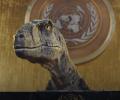
'At least we had an asteroid. What's your excuse?'

Blockchain's promise: Dramatically speeding up transactions, explains Ajit Balakrishnan.

As more organisations across sectors awaken to the far-reaching benefits of having skilled data professionals on board, the demand is projected to grow by 28% by 2026, notes Subramanyam Reddy, founder and CEO, KnowledgeHut, a global edtech firm.

'Whether the substantial hybrid immunity present in India can protect against severe consequences of the disease remains to be seen.'

'After he died the phrase that struck me most about him was that 'Sam restored the izaat of the Army'.' Field Marshal Sam Manekshaw's grandson Raoul-Sam Daruwala remembers the man behind the uniform. Field Marshal Sam Manekshaw's grandson Raoul-Sam Daruwala remembers the man behind the uniform.

'Everything is possible if you are willing to give it your best shot.' 'And while you go about achieving your dreams, don't forget to care for our planet.'

HR Guru Mayank Rautela offers practical advice.

Billionaires are not only eyeing a profit as they push mankind out into the stars.
It appears India will be among those nations consigned to being among the watchers and not participants of this crucial phase, observes Aakar Patel.

One should appreciate the sagacity and audacity of JRD and Nani Palkhivala in founding TCS on April 1, 1968. At that time there was no Microsoft or Intel, SAP or Accenture, much less Google.
They needed a person who could build and execute their vision: A frontiersman; a problem solver and an institution builder. It was their and India's good fortune that Faqir Chand Kohli more than measured up to their requirements and indeed laid the foundation to take TCS to unimaginable heights and to the giant success that it is today. Shivanand Kanavi salutes the incomparable F C Kohli, who passed into the ages last week.

Ola Electric is moving the delivery for the first batch of its electric scooters to between December 15 to the end of the month, a two- to four-week delay from its earlier schedule, due to a shortage of chipsets and electronic parts. The first batch of deliveries were scheduled for November 30 but the company decided to delay them after a meeting between its factory team and the global supply chain on Saturday. It became clear that the late delivery of chips and electronic parts was only 'getting worse', sources told Business Standard. Ola has apologised to customers for the delay and said it is "ramping up production as fast as we can so that you can get your Ola S1 at the earliest". It has stopped taking any new bookings until the chip shortage has eased, say sources.

'He is a busy man these days, still, he makes it a point to call me at least once a month.'
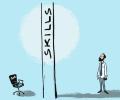
'As the demand for transferable skills that can be remotely applied increases, the need for tech-based courses is on the rise/'
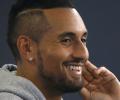
No complaints but quarantine differentials were a mistake: Zverev

Future, even present, wars -- at least those involving such tech giants as China -- include hi-tech battlefields, which a Pakistan-obsessed India has not sufficiently prioritised. Today's generals plan on how to disrupt an enemy city's power supplies, rail networks, airports, ports, and government departments, not just by bombing or torpedoing them; they also examine the option of tripping up the computer networks that run these, notes David Devadas.
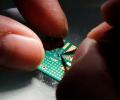
As many as 2,000 chips are annually designed in India by semi-conductor and fabless companies, Intel India managing director Prakash Mallya said in a conversation with Business Standard. Mallya was reiterating the importance of India in the semi-conductor sweepstakes. "As much as 90 per cent of the semi-conductor companies have a design footprint in India.

The lawyer who picked up the pistol and won plenty of medals in shooting will go back to the court room, ill at ease with the utter lack of activity in the sporting arena due to the COVID-19 pandemic. And Abhishek Verma is fairly confident of striking a balance between shooting and legal practice.

'What would we feel if we found the world behaving the way it has?' 'Forced to fight our own prolonged battle; nobody from outside really demanding that the war end or actively working to make it end, and above all, a completely toothless United Nations reduced to pleading for a halt to the violence,' notes Shyam G Menon, exactly a month after Vladimir Putin ordered the invasion of Ukraine.
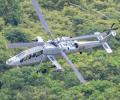
All of India welcomes the Light Combat Helicopter into the Armed Forces arsenal and wishes it a safe tenure and happy shooting. May it rule the skies and ensure that the enemies are given a fitting reply when the need arises.

With the changes in the workplace, in-demand skills, flexibility and being tech-savvy will help you save your job.

Care comes from a place of 'What is good for my child's development?' Care is a long-term view of the child's flourishing in life. Care is a sacred activity and it begins at home.

'Everybody says 5G and communication is important.' 'Everybody says automation, robotics, human computing interfaces -- people and machines working together -- is the future.' 'Everybody agrees that cybersecurity is something that is here to stay.' 'Everybody agrees that synthetic biology is important.' 'Instead of outlining thinking about industries for tomorrow and the future, let the evolutionary pathway be built in a way that it promotes robust, creative, thinking.'

Google CEO Sundar Pichai on Thursday said the company continues to engage closely with partner Jio on the initiative of building an affordable smartphone and that work is underway on the project. Last year, Google had picked up a 7.7 per cent stake in Jio Platforms for Rs 33,737 crore. It had also entered into a commercial agreement with Jio Platforms to jointly develop an entry-level, affordable smartphone.

'Whoever owns the best chip industry will be the Saudi Arabia of the era of data,' predicts Rajeev Srinivasan.

'And they are going to be milder because we are dealing with the vaccinated and are much richer in terms of the immune response in the population.'
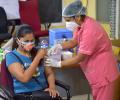
'Centres like polling booths can be set up for the area till the last adult is vaccinated -- open on all days from 9-9.' 'People should be able to come as per their convenience.'

'In the likelihood that Omicron is circulating, you have a much greater chance of getting infected now, than you did during the Age of Delta.'

Even devices such as connected lights, doorbells -- even garden sprinklers -- are all at risk from attackers who can remotely, or even physically, access them to dump firmware, warns Nir Chako, security research team leader, CyberArk, a security software company.

Risk is difficult to evaluate, warns Harsh Roongta.

'I used to be crazy about dates, about car numbers, phone numbers and people would ask, "How can you remember all these things?".'

The ability to make smarter data-driven decisions will be a critical skill that every employer will be looking at in every prospective employee.


Exam centres will not only ensure social distancing among examinees -- there will also be a strong focus on avoiding malpractices and conducting the test with minimal human intervention.

'...signatures.' 'But such signatures are missing in this virus.'

Individuals who can understand data and go for data driven decisions making using their critical mind will be highly valued.
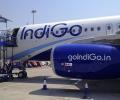
IndiGo, India's largest airline, is in talks to raise fresh funds as a second wave of pandemic has led to collapse in travel demand. The airline may look to raise Rs 3,500-4,000 crore. On Monday, only 97,761 passengers flew. With flyers cancelling bookings, airlines had to put aside flights and operated only 1,306 of them.

China, Russia, Iran and international terrorism form the 'big four' set of security threats in an era of dramatic change, Britain's chief spy said in a rare public speech on Tuesday.
'Failure is success delayed. It teaches you to be patient and persevere so that you improve.'

Part of landing your dream job involves knowing the ins and outs of that particular job.

'It looked as if India had been a major player in science at that time, raising the question when and why things changed,' says distinguished aerospace scientist Professor Roddam Narasimha.
